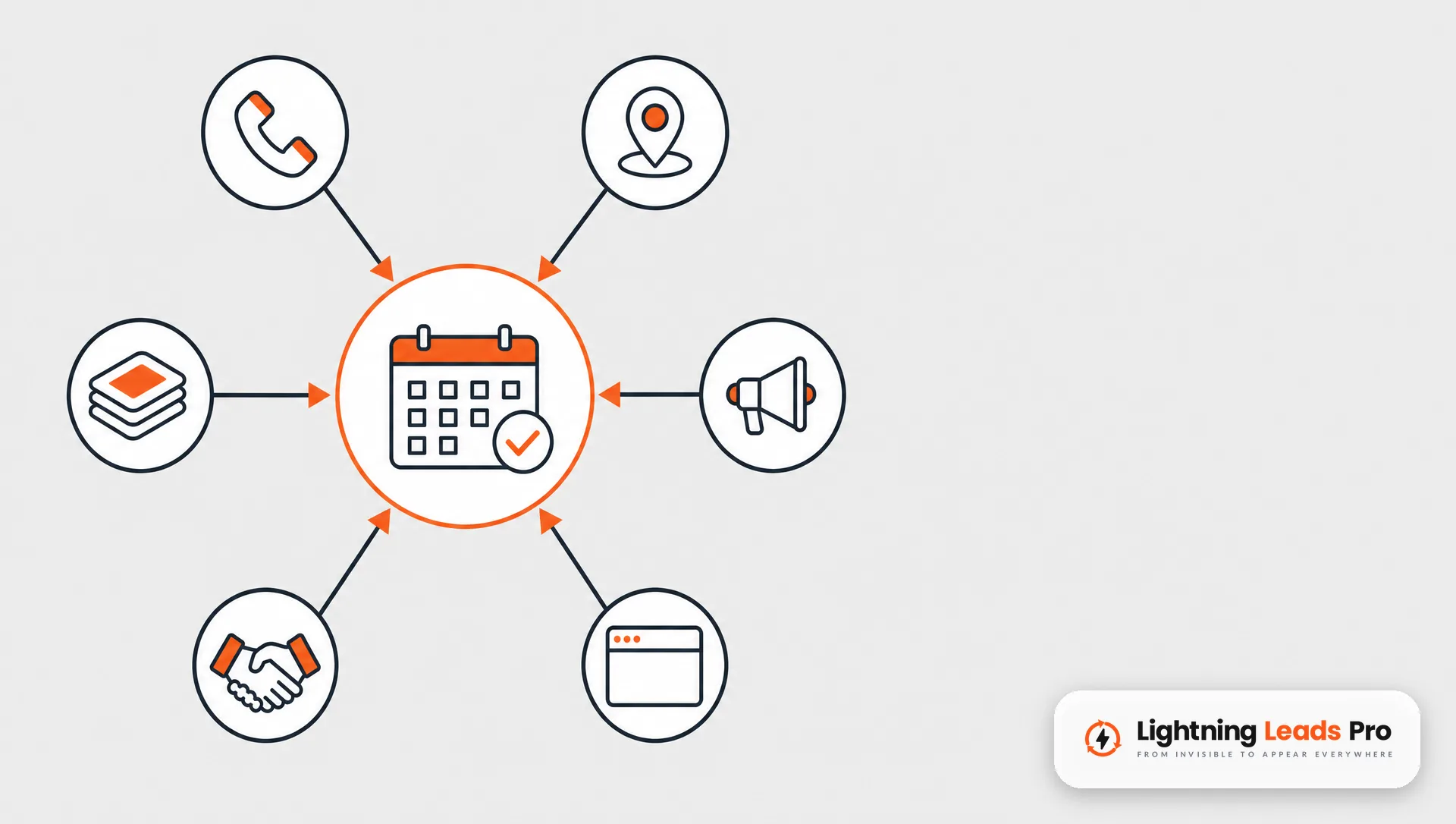
HVAC lead generation is any way a homeowner finds you and reaches out. For most companies, calls come from six places. Those are lead sites, Local Services Ads, Google and Meta ads, the map pack, your own website, and referrals.
Each one bills you in a different way. Each one also gives you a different level of control over the customer. This guide compares them side by side, so you can see what you are really buying.
The short answer: do not judge any source by how many leads it sends. Judge it by how many jobs it books, and what each booked job costs you.
What HVAC lead generation really means for an owner
A lead is a call, a text or a form. A booked job is a truck in a driveway. The gap between the two is where most marketing money gets lost.
Some leads are wrong numbers or spam. Some want a service you do not offer. Some call several companies and book the first one that answers. So two sources with the same lead count can produce very different revenue.
For each source below, we look at four things:
- How you pay: per lead, per click, per view, a monthly fee, or your own time.
- Who owns the customer: whose platform the first contact happens on, and what you keep if you stop paying.
- What to watch: the common ways money leaks out.
- How to judge it: the booked job numbers that tell you if it is working.
Shared and pay-per-lead sites
Lead sites collect requests from homeowners and pass them to contractors for a fee. Thumbtack is one example. Its page for pros says there is no charge to join. It also says you control your pricing and budget for leads, which sets how many you get.
- How you pay: usually a fee for each lead, sometimes with a budget cap you set. Read the current terms on the site itself.
- Who owns the customer: the first contact happens on the platform. Once you book the job, the customer relationship is yours to keep.
- What to watch: whether other companies get the same request, and what the site counts as a valid lead.
- How to judge it: total lead fees for the month divided by the jobs you booked from them.
Read the claims a lead seller makes with care. In April 2023, the FTC approved a final order against HomeAdvisor over how it marketed its leads to service providers. The order bars false or misleading claims about its leads. That includes claims that the leads are about people ready to hire a service provider.
That case does not mean every lead site is a bad deal. It means you should test any lead seller with your own numbers, not its sales pitch.
Google Local Services Ads
Per Google’s page on how leads work, you are charged for each valid lead. That includes answered calls, messages, voicemails and booking requests.
- How you pay: per valid lead. Google says lead prices can vary by location, job type, lead type and bidding mode.
- Who owns the customer: the customer calls a Google tracking number. Per Google’s Local Services Ads overview, those calls forward to your business phone.
- What to watch: a missed call during business hours can still count as a lead. That happens if the caller waits more than 20 seconds.
- How to judge it: spend minus credits, divided by booked jobs.
Google’s overview also says your ad shows reviews from your Google Business Profile. So a thin profile follows you into the ad. Our full guide to HVAC Local Services Ads covers billing, screening and credits in detail.
Google Ads and Meta ads
Regular Google search ads and Meta ads on Facebook and Instagram work in different ways. Google’s cost-per-click page says you pay for each click on your ads with that bidding method. Meta’s page on how it charges for ads says you are usually charged for impressions. That changes only if you pick another option when you build the ad.
- How you pay: per click or per view, inside a budget you set. Clicks and views are not leads yet.
- Who owns the customer: the call or form comes straight to your phone or website. Keep the ad accounts in your company’s name, so the history stays with you.
- What to watch: clicks that never call, and ads that send people to a page with no clear phone number.
- How to judge it: ad spend plus any management fee, divided by booked jobs.
Tracking matters most here. Google’s page on phone call conversion tracking explains that you can set a minimum call length. Calls that last that long count as conversions. You can also import calls tracked in another system, such as a CRM.
Google search ads reach people who are searching right now. Meta ads reach people as they scroll, before they search. Our paid ads team runs Google and Meta campaigns for HVAC companies.
The map pack and your Google Business Profile
The map pack is the group of business listings with a map that shows on many local searches. Those listings come from Google Business Profiles. Google’s own Business Profile page says creating a profile and listing your business is free.
- How you pay: no fee per call. You pay with time, or with a partner who manages the profile, reviews and photos.
- Who owns the customer: calls ring your number directly. You control the profile and can reply to every review on it.
- What to watch: wrong hours, an old phone number, missing services, and reviews with no reply.
- How to judge it: calls from the profile, then the jobs booked from those calls.
Google gives you some numbers to start with. Per its help page on Business Profile performance, you can see call button clicks. You can also see website clicks and direction requests. Messages and bookings show up when those features apply.
Those numbers are taps, not jobs. Pair them with a call log or a tracking number so you can count booked work. Map pack visibility takes time to build, and it does not stop when an ad budget runs out.
Your own website and local SEO
Your website is the one place online you fully control. It is where many ad clicks, map clicks and referrals end up before they call. A slow or confusing site can waste every other source on this list.
- How you pay: the cost to build and host the site, plus ongoing content and SEO work. No fee per call.
- Who owns the customer: you do. Make sure your company owns the domain, the hosting account and the site files.
- What to watch: pages with no phone number near the top, and forms nobody checks. Also, service pages that skip the cities you serve.
- How to judge it: calls and forms from organic search, then booked jobs from those leads.
Organic traffic takes time to build. Once it grows, it can keep bringing in calls without a per-click charge. Our local SEO work focuses on service pages and the map pack. It also covers the details that help a homeowner call.
Referrals and past customers
Your past customers already know your work. In Nielsen’s 2021 Trust in Advertising study, U.S. respondents rated recommendations from people they know as the most trusted channel, at 89%.
- How you pay: mostly time, plus any reward you offer for a referral that books.
- Who owns the customer: you do, from the first call.
- What to watch: no system for asking, and no way to record who sent whom.
- How to judge it: referral jobs booked per month, and how much they are worth.
The SBA’s marketing guide notes that word-of-mouth campaigns are hard to measure. So add a simple question to every booking call: how did you hear about us? Our step-by-step HVAC referral program guide shows how to set one up.
How to judge HVAC lead generation by booked jobs
Lead counts make every source look busy. Booked jobs show which ones pay. Run the same math for every source, every month:
- Add up everything you paid the source this month. Include ad spend, lead fees and management fees.
- Count the jobs you booked from that source. Use a call log, tracking numbers or your CRM.
- Divide the cost by the booked jobs. That is your cost per booked job.
- Compare it with your average gross profit on those jobs.
- Move next month’s budget toward the sources that book jobs for less.
This only works if your office marks the source of every call. Ask “How did you hear about us?” on every new booking. Write the answer in the same place every time.
Speed matters too. A lead that rings out to voicemail books no job, whatever it cost. If calls slip through during busy weeks, read our guide on choosing an HVAC answering service.

Questions to ask any lead vendor or agency
Whether you buy leads, hire an agency or run ads yourself, these questions help you compare offers fairly:
- Is each lead sent only to my company, or to other companies too?
- What counts as a billable lead, and how do I dispute a bad one?
- Do I own the ad accounts, the website, the domain and the Business Profile?
- Can I hear call recordings or see every form that came in?
- Will your reports show booked jobs, or only clicks and leads?
- What is the contract length, and what happens to my data if I leave?
- What do you need from my office to make this work?
A good partner answers each one in writing. If a vendor will not say who owns the accounts, treat that as your answer.
Frequently asked questions
What is HVAC lead generation?
It is any way a homeowner finds your company and reaches out by call, text or form. Common sources include lead sites, Google and Meta ads, Local Services Ads, the map pack, your website and referrals.
Should I buy HVAC leads or generate my own?
Many companies do both. Bought leads and ads can start fast but stop when you stop paying. Your own profile, website and referral system take longer but stay with you. Compare them by cost per booked job.
How do I know which lead source is working?
Track the source of every call and form, then count booked jobs by source each month. Divide what you spent by the jobs booked. The lowest cost per booked job wins more budget.
Are shared HVAC leads worth it?
It depends on your own numbers. Ask how many other companies get the same request and how fast you can respond. Then test for a full month and judge by booked jobs.
Is Google Business Profile free for HVAC companies?
Yes. Google says creating a Business Profile and listing your business is free. The cost is the time to keep it accurate, add photos and reply to reviews.
Find out where your next calls should come from
No single source fits every HVAC company. The right mix depends on your market, your crew size and how fast your office answers the phone.
Want to see how your profile, website and ads compare with the competitors near you? Book a Free Local Lead Growth Session and we will walk through your numbers with you.